Some of the features now available are:
Showing posts with label Learn. Show all posts
KDE Connect - Mobile Integration
Some of the features now available are:
Podcasts with gPodder
gPodder downloads free audio and video content (podcasts) for you Listen directly on your computer or on your mobile devices. If you have an android device you can follow my guide at Android Relish on Podax Podcasting & gPodder. In the guide it mentions the gPodder.net service and Podcast Directory, the desktop and mobile version can both be synced with the free gPodder.net service. The website has been unreachable once but aside from that there isn't a better place to discover and manage good podcasts.
gPodder is available for Linux, FreeBSD, Windows, Mac OS X and mobile devices like the Nokia N810, N900 and N9. Some of the highlights are that it has support for RSS, Atom, YouTube, Soundcloud, Vimeo and XSPF feeds, as well as exporting to OPML which can then be imported on an Android device. Easily synchronize between devices with full gpodder.net API support. gPodder is also easy customization with its' choice of supporting Python as it's extension language.
Homepage: http://gpodder.org/
Download: http://gpodder.org/downloads
Documentation: http://gpodder.org/documentation
Source Code: http://gpodder.org/wiki/Git
Wiki: http://wiki.gpodder.org/
Tutorial for using the gPodder.net for syncing multiple devices.
Android Relish - Podax Podcasts & gPodder
Mixxx - DJ Software Review
Mixxx has everything you need to start making DJ mixes in a tight, integrated package. Whether you're DJing your next house party, spinning at a club, or broadcasting as a radio DJ, Mixxx has what you need to do it right.
Best of all it's Open Source, free and available for Windows, Mac, and Linux!
Here is a quick 5 minute review of Mixxx by InfinityGalatic (who's been doing Linux App reviews on youtube). He is using the Ubuntu Linux Operating System which is also free and Open Source.
Links:
Download: Mixxx DJ Software http://www.mixxx.org
Download: Ubuntu Linux http://www.ubuntu.com
Old Post featuring Mixxx http://openrelish.blogspot.com/2011/10/dj-software.html
The Internet Archive Offers Over 1 Million Torrents
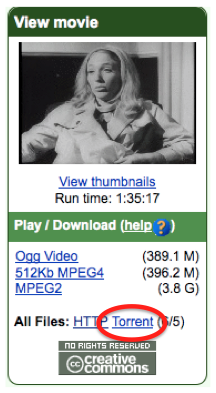
The Internet Archive has seeded over 1,000,000 torrents of creative commons and public domain media, as well as complete websites
The Internet Archive is a non-profit digital library with the stated mission of "universal access to all knowledge". The Internet Archive permanent handles the storage of and free public access to collections of digitized materials, including websites, music, moving images, and nearly 3 million public-domain books. The only problem is that it costs so much to share that infomation with direct downloads, torrents are the perfect way to share this legal content.
Torrent is a protocol for computers to communicate and share files in such a way that as a user downloads a file they share it as well. When a user has the full download they can choose to seed the torrent longer or remove it from the torrent application while keeping the downloaded data. A single torrent file can have hundreds of files in it, and users can choose to download certain files or the whole torrent.
A torrent file only works with a torrent downloading program. The Opera web browser can handle torrent files and I'd recommend using Opera, it has allot of good features and is secure. If your running a Linux operating system there is most likely a torrent application installed by default. For windows users the best torrent programs are Azureus which is open source and hosted by sourceforge.net it is also a torrent browser and media player. Utorrent also has torrent browsing capabilities but is more lightweight.
Internet Archive blog post - 1000000-torrents-of-downloadable-books-music-and-movies
Internet Archive - Torrent Hotlist
Internet Archive - Torrents Over a Million Books
The Internet Archive is a non-profit digital library with the stated mission of "universal access to all knowledge". The Internet Archive permanent handles the storage of and free public access to collections of digitized materials, including websites, music, moving images, and nearly 3 million public-domain books. The only problem is that it costs so much to share that infomation with direct downloads, torrents are the perfect way to share this legal content.
Torrent is a protocol for computers to communicate and share files in such a way that as a user downloads a file they share it as well. When a user has the full download they can choose to seed the torrent longer or remove it from the torrent application while keeping the downloaded data. A single torrent file can have hundreds of files in it, and users can choose to download certain files or the whole torrent.
A torrent file only works with a torrent downloading program. The Opera web browser can handle torrent files and I'd recommend using Opera, it has allot of good features and is secure. If your running a Linux operating system there is most likely a torrent application installed by default. For windows users the best torrent programs are Azureus which is open source and hosted by sourceforge.net it is also a torrent browser and media player. Utorrent also has torrent browsing capabilities but is more lightweight.
Internet Archive blog post - 1000000-torrents-of-downloadable-books-music-and-movies
Internet Archive - Torrent Hotlist
Internet Archive - Torrents Over a Million Books
Django/Rails-Like Rapid Development for Ubuntu
Glade + Python is about as easy as it gets for doing Linux GUI development.
With Glade you build a XML-file describing a Gnome graphical user interface using a GUI editor.
http://glade.gnome.org/
The boiler plate code for a Python GTK project would be some stuff like importing the libraries you need, loading the Glade XML file, creating the initial class for your application and then starting up the gtk.main()-style mainloop.
Once that is done then it's mearly a matter of defining class methods and assigning them to your various buttons.
This tool works perfect for the novice programmer just about anyone should be able to get from zero to 'hello world' GUI program in about 2 minutes. With full version control, build environment, and the ability to easily create installable packages.
From there on everyhing from accessing the hdd, remote file systems, dbus for system events, gstreamer transcoding/encoding/decoding, telepathy for integration into online services, and all that happy stuff is just a few edits away.
Installation
$ sudo apt-get install quickly quickly-ubuntu-templateBegin Tutorial
$ quickly tutorial ubuntu-applicationResources
https://wiki.ubuntu.com/Quicklyhttp://developer.ubuntu.com/resources/tools/quickly/
http://blog.didrocks.fr/post/Quickly-0.4-available-in-lucid!
New To Programming? Learn Python, which is a good choice for learning programming.
http://www.learnpython.org/
http://docs.python.org/tutorial/
http://code.google.com/edu/languages/google-python-class/
Old articles about Quickly
arstechnica.com - quickly-new-rails-like-rapid-development-tools-for-ubuntu -2010
zdnet.com - unchaining-the-opportunistic-programmer - 2009
ChronoZoom
More and more open source projects are sprouting into existence, and they are not just software projects they are hardware and educational resources as well. The ChronoZoom project is an HTML5 piece of software but is more then that, it is a new way to browse, learn and contribute to a wealth of knowledge. Even though it runs o the Azure platform this looks like a cool project, hope it gains momentum quickly.
Click this link to open chronozoom, at the top left corner there is a film-strip icon, click it to show the introduction tab and select with or without audio
http://www.chronozoomproject.org/ - if the link doesn't work in Internet Explorer (your version is out of date), it will work in google Chrome, as well as Firefox 10.x and up.
The code is hosted on codeplex @ http://chronozoom.codeplex.com/
The project is described as "an open source community project dedicated to visualizing the history of everything to bridge the gap between the humanities and sciences using the story of Big History to easily understand all this information."
"With ChronoZoom," Saekow told Ars, "you can browse history, rather than digging it out piece by piece. Also, today with [fewer and fewer] students visiting the library, the serendipity of browsing for a book and finding another is something we hope ChronoZoom can restore. If you don't know what to search for, it's almost like that topic never existed."
Now comes the time in the project's development where open source comes into its own.
"We envision a world where scientists, researchers, students, and teachers collaborate through ChronoZoom to share information via data, tours, and insight," the ChronoZoom team writes. "Imagine a world where the leading academics publish their findings to the world in a manner that can easily be accessed and compared to other data. We will be focusing on community development of features, capabilities, and content."
Subscribe to:
Posts (Atom)